Matisse och PicassoMatisse and Picasso
De var konstens två stormakter under 1900-talets första hälft, och de visste om det. I nästan femtio år tävlade de, lånade av varandra och höll ett vakande öga på vad den andre gjorde.
They were the two great powers of art in the first half of the 20th century, and they knew it. For almost fifty years they competed, borrowed from each other and kept a close watch on what the other was doing.
Mötet hos SteinMeeting at the Steins’
De träffades omkring 1906 i Gertrude och Leo Steins salong i Paris, där väggarna redan var fulla av bådas verk. Matisse var tolv år äldre, erkänd och borgerligt korrekt. Picasso var den unge, rastlöse spanjoren från Montmartre.
They met around 1906 at Gertrude and Leo Stein’s salon in Paris, where the walls were already full of work by both. Matisse was twelve years older, established and bourgeois in manner. Picasso was the young, restless Spaniard from Montmartre.
En tävling i måleriA contest in paint
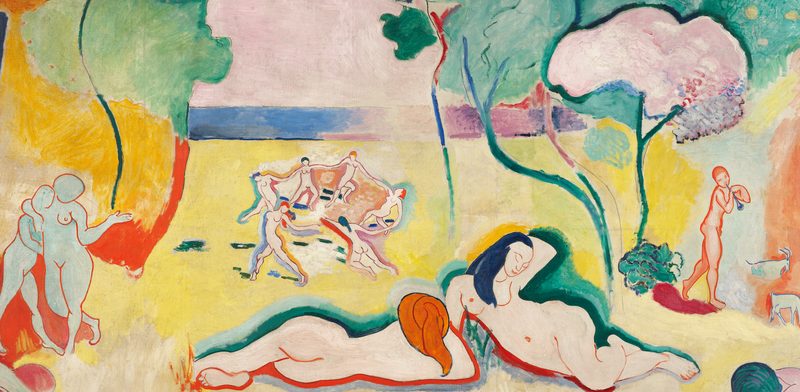
Matisses Livsglädjen visades 1906 och väckte stor uppmärksamhet. Många konsthistoriker ser Picassos Les Demoiselles d’Avignon från 1907 delvis som ett svar: där Matisse målade harmoni slog Picasso sönder formen. Strax därefter utvecklade Picasso och Braque kubismen, medan Matisse gick vidare mot färg och yta.
Matisse’s The Joy of Life was shown in 1906 and caused a stir. Many art historians see Picasso’s Les Demoiselles d’Avignon of 1907 partly as a reply: where Matisse painted harmony, Picasso broke form apart. Soon after, Picasso and Braque developed Cubism, while Matisse pushed on towards colour and surface.
Utbytta målningarSwapped paintings
År 1907 bytte de målningar med varandra. Picasso valde ett porträtt av Matisses dotter Marguerite, och Matisse fick ett stilleben av Picasso. Ett sådant byte var ett sätt att visa respekt, och ett sätt att studera rivalens metoder på nära håll.
In 1907 they exchanged paintings. Picasso chose a portrait of Matisse’s daughter Marguerite, and Matisse received a still life by Picasso. A swap like this was a mark of respect, and a way to study a rival’s methods up close.
Vänskapen på äldre dagarFriendship in later life
Under och efter andra världskriget bodde Matisse i södra Frankrike, och Picasso besökte honom i Nice och Vence. De visade varandra nya verk, och Picasso följde klippbilderna noga. Efter Matisses död 1954 sade Picasso att Matisse hade lämnat sina odalisker i arv till honom, och han började samma vinter på en lång serie målningar efter Delacroix kvinnor i Alger.
During and after the Second World War Matisse lived in the south of France, and Picasso visited him in Nice and Vence. They showed each other new work, and Picasso followed the cut-outs closely. After Matisse died in 1954, Picasso said Matisse had left him his odalisques as a legacy, and that winter he began a long series of paintings after Delacroix’s Women of Algiers.
Sida vid sidaSide by side
År 2002 och 2003 visades de tillsammans i den stora utställningen Matisse Picasso i London, Paris och New York. Den visade hur ofta de målade samma motiv, och hur olika de löste dem.
In 2002 and 2003 they were shown together in the major exhibition Matisse Picasso in London, Paris and New York. It revealed how often they tackled the same subjects, and how differently they solved them.